



By: Zach Walden, CSP, NRP, Director of Port Safety – Hampton Roads Shipping Association
Erick Hawley-Saia, Director of Safety & Loss Control – Greenwich Terminals
–
Walk into almost any fire station, hazmat unit, or port security office in North America and you’ll find a small, well-worn orange book tucked into a cab compartment, a gear bag, or a duty desk drawer. That book is the Emergency Response Guidebook, the ERG, and for first responders arriving at a chemical emergency on a maritime container terminal, it is often the first tool they reach for.
In addition to an ERG book the Pipeline and Hazardous Materials Safety Administration (PHMSA / DOT) has also produced a mobile application that can be downloaded at no cost, and and allows this resource to be carried anywhere you take your phone:
Get the app here!
(Note: Although very convenient to have this resource as a mobile application it is not considered compliant with 49 CFR Part 172 Subpart G – Emergency Response Information. This is to ensure that emergency response information is consistently supplied together with shipping papers in an accessible manner. The official ERG publication, and any errata, are the final authority for this information.) (ERG 2024 app > About the ERG 2024)
But what exactly is the ERG, and how do responders actually use it in the field? For the public watching from a safe distance as responders in turnout gear consult a little orange book before approaching a leaking container, the scene can look almost deceptively casual. It isn’t. What’s happening in those moments is a disciplined, practiced process that can mean the difference between a controlled incident and a catastrophe.
What the ERG Is and What It Isn’t
The Emergency Response Guidebook is published jointly by the U.S. Department of Transportation, Transport Canada, and their Mexican counterpart – Secretaria de Infraestructura, Comunicaciones y Transportes (SICT), and updated every four years. The 2024 edition covers nearly 4,000 hazardous materials. It is designed specifically for the first 30 minutes of a hazardous materials incident, before the facility’s safety data sheets have been located, and before a regional hazmat team has fully staged.
The ERG is not a comprehensive chemical encyclopedia. It doesn’t replace a toxicologist or a hazmat specialist. What it does…remarkably well… is give a first responder actionable, conservative guidance in the first critical minutes of an incident, when information is scarce and the stakes are high.
At a maritime container terminal, those first minutes are complicated by a factor that makes the ERG indispensable: volume and variety. A working container terminal may have thousands of containers on the yard at any given time, representing dozens of countries of origin, hundreds of shippers, and an enormous range of commodities including hazardous materials ranging from flammable liquids and compressed gases to infectious substances and radioactive materials. No responder can carry that knowledge in their head. That’s where the ERG makes things not only easier, but supports making informed decisions about what to do, or what not to do, at the start of a hazardous materials emergency.
The Placard Is the Starting Point
When a container is reported to be leaking, smoking, on fire, or otherwise in distress, the first thing responders look for, before they get anywhere close, is the placard. International maritime regulations require hazardous materials to be placarded on their containers using the United Nations’ UN/DOT hazard class system: a diamond-shaped sign in a specific color, bearing a class number, a symbol that helps to communicate the material’s hazard (i.e. a flame for flammable materials or skull & cross bones for toxic cargo), and, depending on the quantities being shipped, a four-digit UN number identifying the specific material.
That UN number (UN for “United Nations”) is the key to the ERG.
The ERG’s yellow-bordered pages list every UN number in numerical order while the blue pages list the same chemicals by name alphabetically. Why both? If a responder can read the placard from a safe distance and sees a UN number — through binoculars, if necessary — they can look it up immediately. If there is no UN number visible but the product name is known, they go straight to the blue pages. Either way, the yellow and blue pages are indexes pointing to the same destination: a three-digit guide number in the orange pages.
Those orange guides form the heart of the book. Each one covers a family of materials with similar hazard profiles rather than a single chemical, giving responders immediate direction on protective actions, fire response, and spill or leak considerations for an entire category of hazardous materials — roughly 60 guides covering the full spectrum of dangerous goods.
For certain high-hazard materials — particularly those that are toxic by inhalation — the index pages will flag that the green pages at the back of the book should also be consulted. The green pages provide initial isolation distances and protective action distances specific to those materials, a critical layer of guidance that the orange guides alone don’t capture.
What the Guides Actually Tell Responders
Each ERG Guide is a summary structured around three essential questions every first responder must answer:
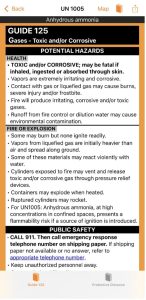
- What are the immediate hazards? The Guide describes fire and explosion risks, health hazards, and the primary routes of exposure such as whether the material is dangerous by inhalation, skin contact, ingestion, or some combination. For example, a material like Anhydrous ammonia, UN1005, a common refrigerant cargo at ports, the guide makes clear within seconds that the primary hazard is health via inhalation of a toxic gas that is also potentially flammable under certain conditions, though inhalation toxicity is the primary operational concern.
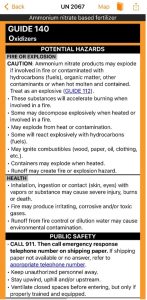
- Compare now if the material was Ammonium Nitrate Based Fertilizer (UN2067) – Guide 140. As previously mentioned within moments the reader will know that this presents a significant fire or explosion hazard. However, beyond the detailed descriptions on the page how else can Responders tell that the fire or explosion hazard is their first concern? It’s listed above the health section. Both hazards must be mitigated and controlled, but for UN2067 the first concern is fire or explosion.

- Compare now if the material was Ammonium Nitrate Based Fertilizer (UN2067) – Guide 140. As previously mentioned within moments the reader will know that this presents a significant fire or explosion hazard. However, beyond the detailed descriptions on the page how else can Responders tell that the fire or explosion hazard is their first concern? It’s listed above the health section. Both hazards must be mitigated and controlled, but for UN2067 the first concern is fire or explosion.
-
- Return to the Guide Number for Anhydrous Ammonia (UN1005) – Guide 125. What’s the first of the two hazards listed? HEALTH. Again, both hazards must be mitigated and controlled, but for UN1005 the first concern is its health effects.
- What protective actions are needed? This is where the ERG becomes most immediately operational. Each guide specifies what personal protective equipment (PPE) is appropriate and …critically… references the isolation and protective action distances in the green-bordered pages at the back of the book.
For certain materials labeled as particularly dangerous (marked with a green highlight in the yellow or blue indexes), the green pages provide initial isolation distances, how far to keep all non-essential personnel and protective action distances, and how far downwind to consider evacuating or sheltering in place depending on whether it is a small or large spill. These distances are derived from atmospheric dispersion modeling and account for both daytime and nighttime conditions, since atmospheric stability and temperature affects how a released vapor cloud behaves.
Reality Check
Emergency responders are a wealth of knowledge and capability. A combination of skills that are an asset in any emergency incident, planning discussions, or board room. But, like us all, they can’t know everything. The previous paragraph mentions atmospheric stability and the physics of vapor releases. You think they can spit out a dissertation on these topics?
NO!
They (most likely) can’t.
But their understanding of those dynamics in combination with the ERG is exactly how they earn our trust and can do their jobs effectively.
End Rant
At a container terminal, this matters enormously. A release in a congested terminal yard, near a gate with inbound truck traffic, near a vessel at berth, or near a densely populated waterfront is not an abstract scenario, it is the operating environment. Responders use those green-page distances to make immediate decisions about whether to begin evacuating the terminal, shelter in place, notify the vessel, or request the Coast Guard to establish a safety zone on the water.
- What emergency response actions are appropriate? The guide describes first aid measures, fire suppression guidance (including what not to use…some materials react violently with water), spill and leak response, and whether evacuation or shelter-in-place is more appropriate for different scenarios.
The Decision Tree in Real Time
At a maritime terminal incident, a responder’s ERG-guided process typically looks something like this:
Upon arrival, they stage upwind and uphill, a principle reinforced throughout the ERG, at a distance that keeps them out of any potential vapor cloud or splash zone. From that position, they observe.
- What is the placard?
- What is the UN number?
- Is there visible vapor, smoke, or liquid?
- What are the wind conditions?
With the UN number in hand, the ERG lookup takes roughly 30 seconds for a trained user. The guide number leads immediately to the response page. Within two minutes of arrival, a responder can have a working understanding of the hazard family, appropriate PPE levels, and whether to escalate to a full hazmat response or whether the situation can be managed with standard firefighting resources.
Simultaneously, that guide number and the material information go to dispatch, who can relay it to incoming units. This one critical determination ensures that mutual aid responders arriving from neighboring jurisdictions have the same baseline hazard information before they arrive on scene.
When the ERG Is Not Enough and Responders Know It
One of the most important things about ERG training is this: it teaches responders not just how to use the book, but when to go beyond it. The ERG is explicitly designed for the first 30 minutes. After that window, the expectation is that responders have accessed better information sources, and if necessary have begun organizing their Unified Command and resources are being called in and staged.
At a maritime terminal, basic understanding of hazardous materials being shipped through the terminal, placard recognition, safety and security procedures, and emergency response plans create a powerful partnership between the terminal and responders that are arriving.
Building that partnership starts before any call comes in. Frontline managers and supervisors are frequently the initial responders on the job, so it is recommended that they receive ERG training and keep a copy of the guidebook—or the ERG mobile app pre-downloaded—readily available in the event of an incident. Beyond the responders themselves, a printed copy of the ERG should be stored or located in the vicinity of the site’s Emergency Action Plans within the container terminal. But in practice, you should keep the ERG where it is needed when it is needed. Your desk, your bag, work truck, pocket, phone. Wherever you think you need one at the ready, that’s where you should have one…..and a back up.
What is it and how can it hurt me?
A very simple and direct question that, when able to be answered, empowers those affected by the incident to not only plan effectively, but also support their Responders as the incident evolves.
_____________________________________________________________________________
Reference(s)
- ERG 2024 for iOS distributed by the U.S. Department of Transportation (DOT) Pipeline and Hazardous Materials Safety Administration (PHMSA). Translation and testing provided by Canadian Transport Emergency Center (CANUTEC). http://www.phmsa.dot.gov/hazmat/outreach-training/erg